
Protecting reptiles during restoration
The challenge the team increasingly face is how to carry out effective peatland restoration while avoiding causing harm to adders hibernating in degraded peat.
Increasingly, the spots that adders might choose to hibernate on Dartmoor, Cornwall and Exmoor's uplands are the dry and degraded areas that we work on to restore to wet, healthy peat bog. These might be areas with drainage channels and gullies, south facing peat cutting edges, and sheltered areas of cracked and drying peat.
Adders are legally protected and have faced long-term declines in the UK, and we need to do what we can to avoid disturbing or harming them through our work and ensure there remains room for them to thrive in our restored upland landscapes. We’ve worked with Natural England to develop careful survey and mitigation approaches for delivering peatland restoration to limit the risk of accidental injury to hibernating reptiles.
This includes:
🐍Surveys during restoration planning visits, looking for areas of habitat that could be used as hibernating spots.
🐍High-risk areas are then checked again on a warm, sunny September day looking for basking reptiles.
🐍Potential hibernation sites identified will be excluded from works with a buffer put in place too.
🐍We will avoid creating blocks downslope of potential hibernation spots that might raise the water table in the peat and flood these areas.
🐍Groundworks in sensitive areas are done under extra supervision with an ecological watching brief in place.
🐍Contractors receive toolbox talks on reptile protection and safe working practices.
Following restoration works adders will still be present on and around our sites, and will still be able to hibernate on the naturally drier margins of the bog. In addition, adders should benefit in the long term from increased prey availability associated with functioning bog ecosystems, with increases of ground nesting birds, amphibians, and newts which we typically see following restoration all likely to appeal to hungry adders on our sites!
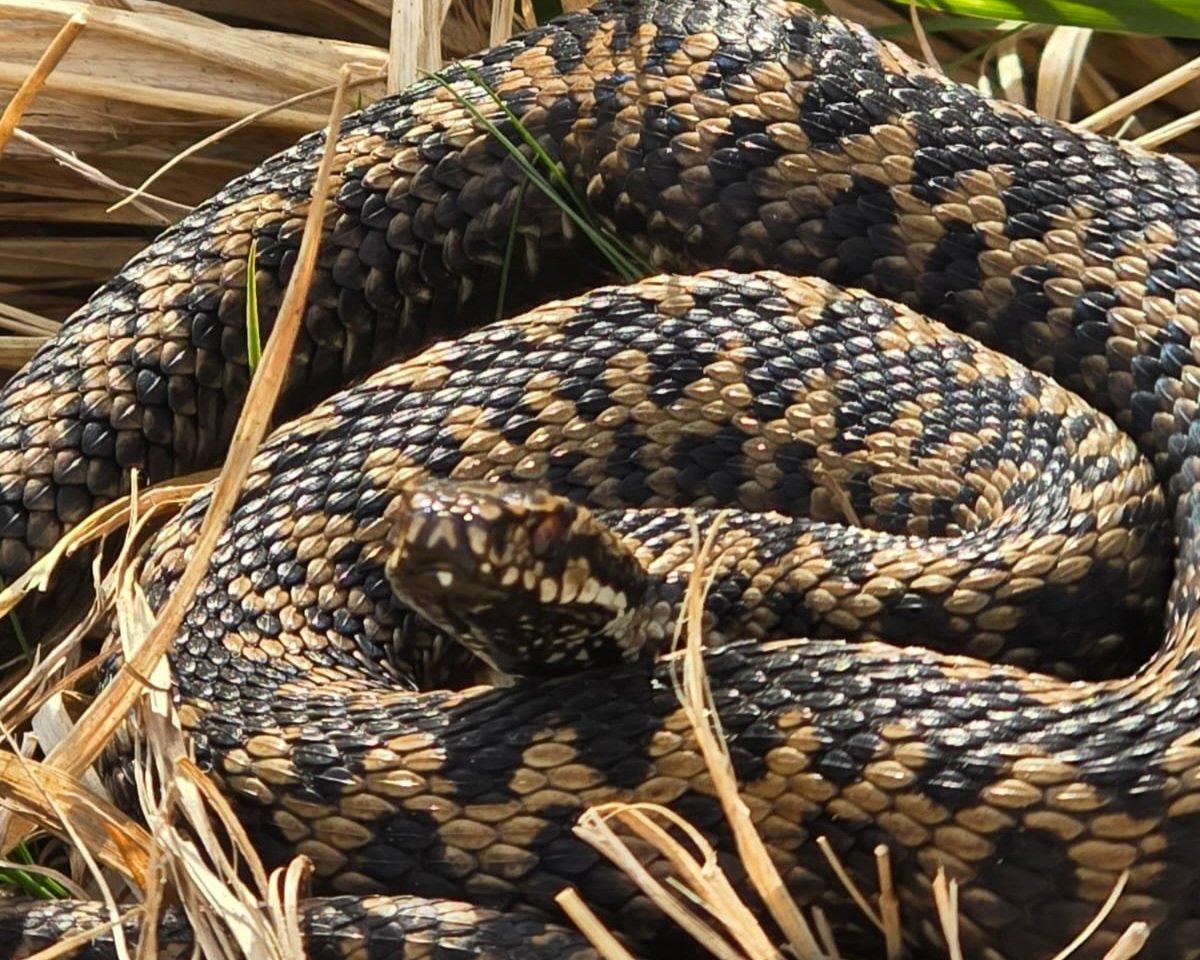
An adder spotted out in the late spring sunshine, taken by one of the team