
The archaeology of peatlands: a resource under threat
Finite, fragile and irreplaceable – this is true of peatlands and even more so for the precious archive of ecological and human heritage that is found in, under, and around them. Peat has been forming on the moors and in the valleys of the UK’s South West since the end of the last Ice Age over 10,000 years ago.
The anoxic conditions within its wet and acidic mass preserve a vast range of organic evidence for changes in the environment and our interaction with it. Pollen, macrofossils (visible organic remains), fungi spores, testate amoeba, microcharcoal; all of these can add up to tell the story of ecosystems and how they are impacted by climate and human activity.
Information held in the peat
Because of its organic nature, peat can be dated by measuring the decay of carbon-14, a radioactive isotope absorbed by all living organisms. Increasingly precise techniques allow us to see changes at a generational level, seeing species come and go within a single person’s lifetime.
This is a vital source of information, especially if we are trying to restore the functions in these systems that collect and hold carbon or promote biodiversity. The most obvious threat to this store of data is the physical loss of peat through erosion. Drainage, mineral extraction, shelling for military training, turf cutting and extreme weather events (exacerbated by climate change) have all contributed to this. As the peat is washed away so that information is lost.
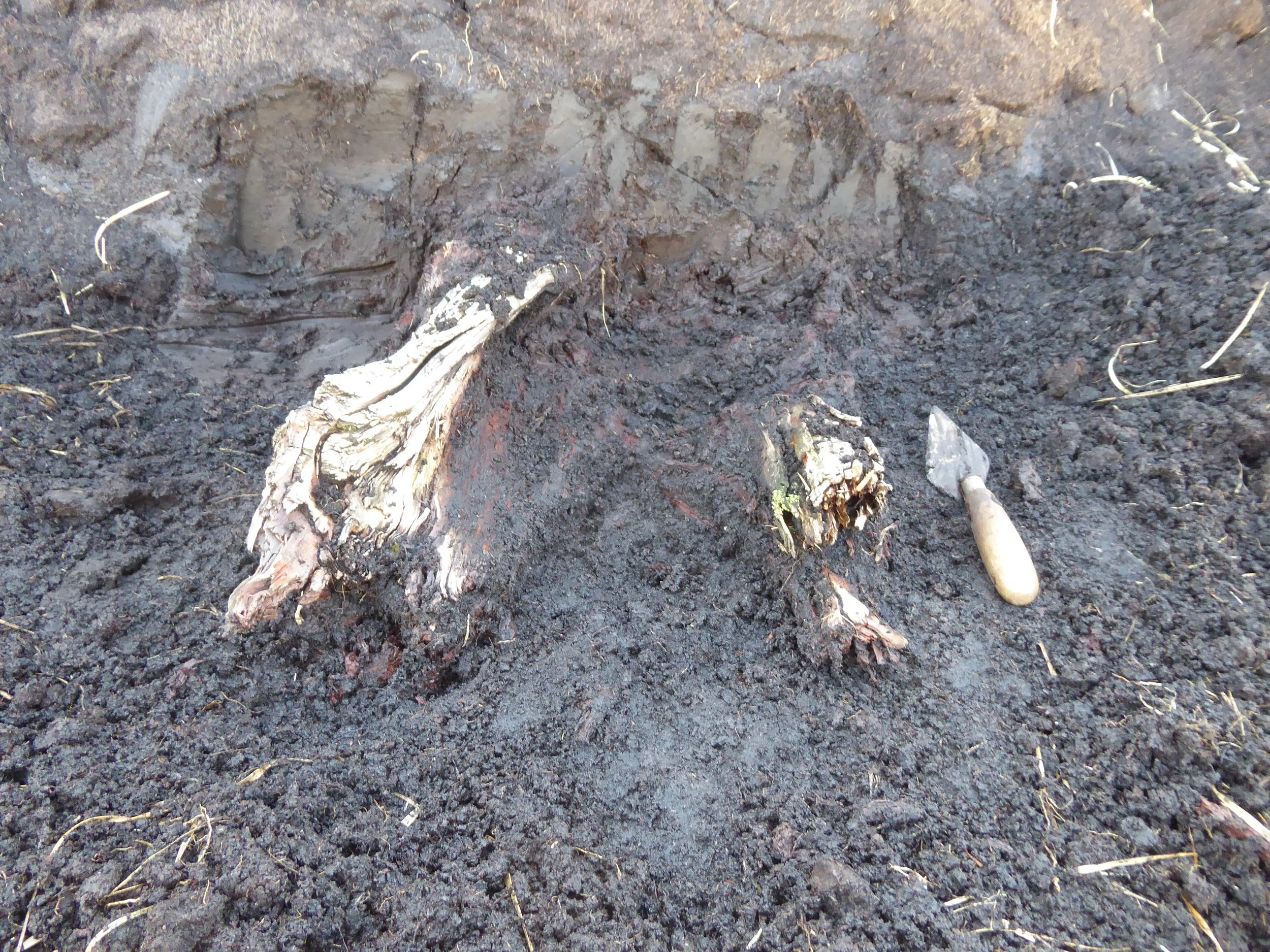
Plant macrofossils found on Dartmoor, probably from a Mesolithic woodland 8-10000 years old
Peat loss and erosion
Related, but far more insidious, is the decay of these remains in situ as the hydrological function of peatlands fails. Cuttings and gullies leave the remaining peat quite literally high and dry. Over time, as oxygen gets to the organic material, its quality deteriorates and eventually is lost entirely. A palaeoenvironmental expert commented on the layers encountered on one Dartmoor restoration site, regarding samples taken from the edge of an historic peat cutting; what was once peat had lost much of the distinctive organic material.
“Throughout site discussions, and this report, the term ‘peat’ is used. The deposits encountered were, however, highly humified organic silts, or humified peaty silts. Most of the main plant structure had decayed and nowhere was there a fibrous layered peat present.”
In addition, the peatlands of Dartmoor, Exmoor and Cornwall contain a mass of archaeological features created on, around, within and under the peat itself. These too are an irreplaceable archive of cultural activities, reminding us that moors and bogs are not empty wildernesses but part of our shared heritage.
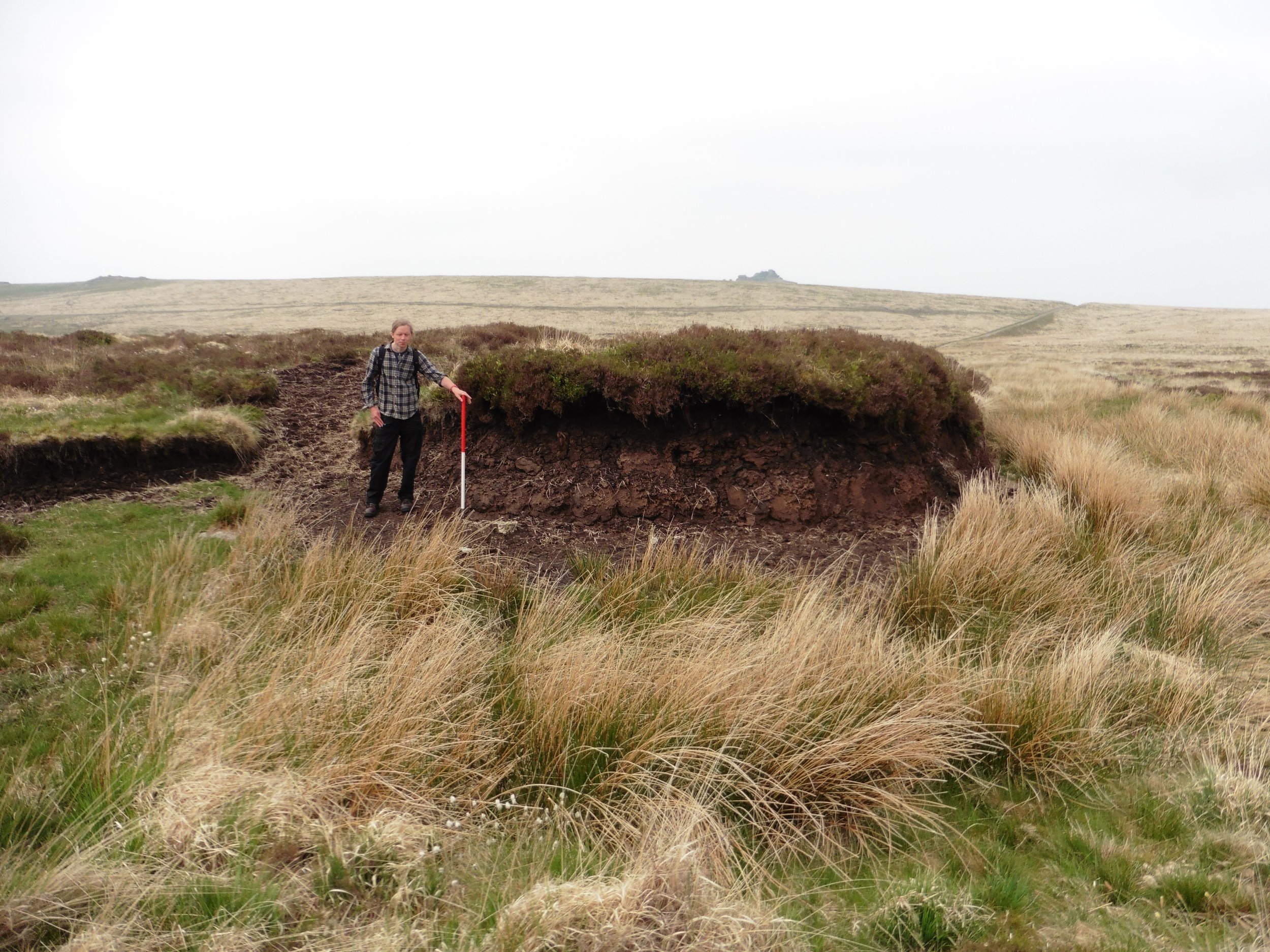
Eroding tramway at the Rattlebrook peatworks, Dartmoor
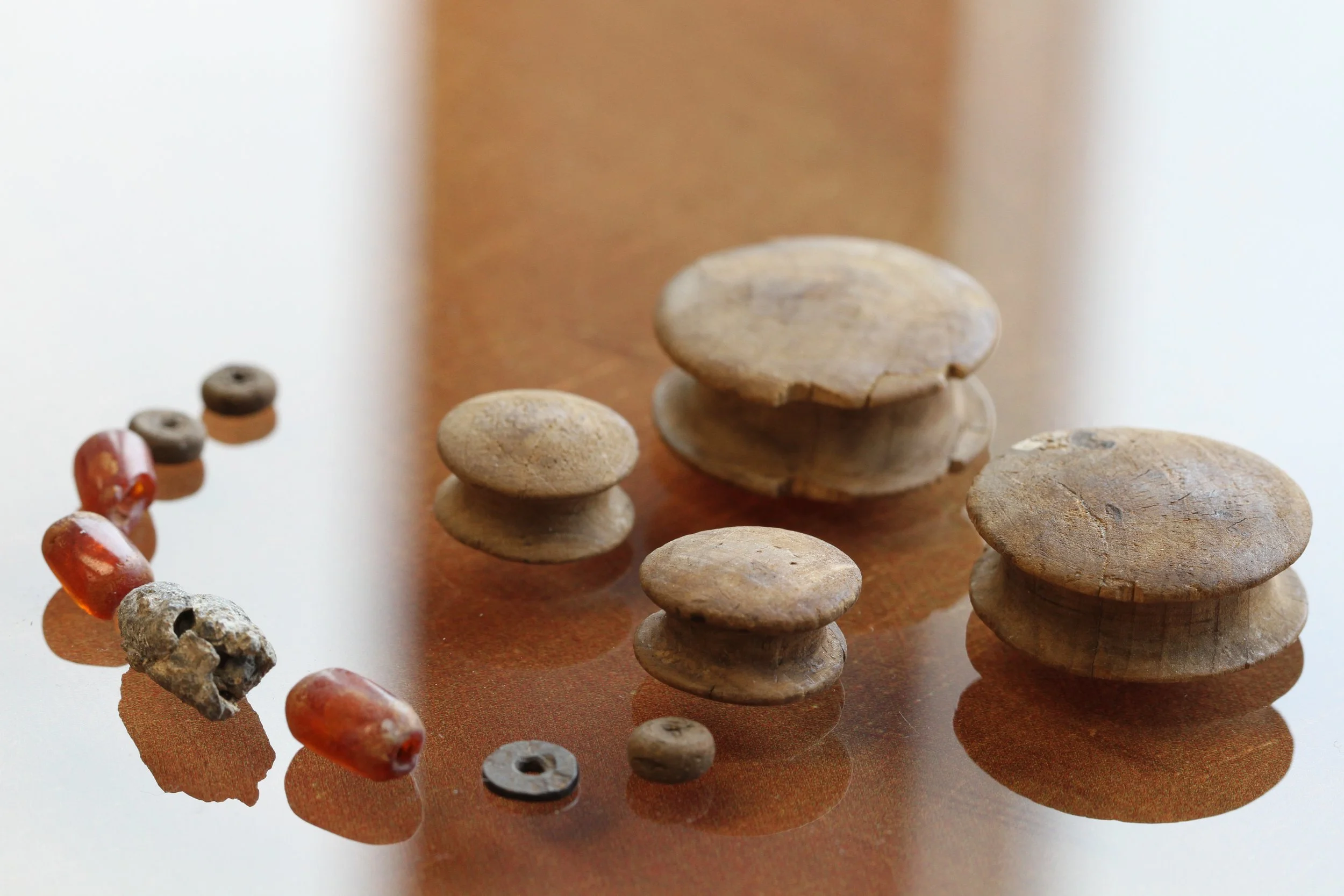
Turned wood and tin, amber and jet beads from the Whitehorse Hill cist. Copyright DNPA
During the Bronze Age (3-4000 years ago) people lived in great numbers in the uplands, leaving behind thousands of roundhouses and field systems covering hundreds of hectares. On Dartmoor and Bodmin Moor the cremated remains of some people were interred within small chambers made of granite slabs known as cists. Over 200 are known but a sum total of only two have been excavated to modern standards. Most eroded out and their contents were lost, or only summarily recorded. Those we have studied show that they contained organic objects, such as the bearskin bag, nettle-fibre bracelet, basketry and turned spindle wood as found at Whitehorse Hill. Such evidence of our shared heritage is fragile and quickly decays when exposed.
In most of the valleys of the granite uplands of the South West are the remains of tinstreaming – an ancient method of extracting tin ore from material eroded in geological time. Water is used to sort the heavy ore from the granite gravel and boulders it is found amongst, and distinctive dumps of waste are left behind. This practise dates from the Bronze Age to the medieval period and beyond, and remains of it are unique to this region in the entire world. However, many examples of this are being lost under eroding peat, sometimes thousands of tonnes of it being dumped out of gullies and covering this evidence.
Historic environment in restoration
Finally, we must be aware that the very practise of peatland restoration poses a threat to the historic environment. Making thousands of mechanical interventions in a landscape that has largely been untouched by intensive agriculture runs the risk of causing irreparable impacts.
Only by assessing the known and potential archaeological resource of proposed restoration sites can we mitigate those risks – avoiding those elements our heritage that we can, and recording those that we cannot.
Blog taken from poster created by SWPP Historic Environment Officer Martin Gillard for the IUCN Peatland Programme Conference in Swansea, June 2026

Area of recent peatland restoration on North Dartmoor