
Behind the SWPP carbon audit report
Peatlands are our largest land-store of carbon. They are however eroding, degrading, and losing huge amount of that store into the atmosphere and rivers.
South West Peatland Partnership restoration activities produce emissions including carbon through machinery use, staff travel and materials. A carbon audit of works and example study site show that the reduction in carbon emissions resulting from the peatland restoration far outweigh the carbon costs of carrying it out. The potential reduction in carbon is huge over the years ahead from restored peatland, and combined with the importance of works for water, wildlife and plants, shows the value of this urgent work.
What are the key findings of the report?
During the year 2023-2024, the SWPP’s restoration works were responsible for 396 tons of CO2 equivalent across the 11 restoration sites, activities, materials and staff travel. This was equivalent to the annual carbon footprint of 49 average UK homes.
Over a 50 year period, emissions from one study site on central Dartmoor could be reduced by up to 15,115 tons of CO2 equivalent as a result of successful restoration work carried out on this area. This work ‘cost’ 58 tons of CO2 equivalent to carry out. This is over a 260x reduction over 50 years.
The three highest contributing activities to the partnership’s total carbon emissions were from materials – 218 tCO2e, restoration activities like equipment and fuel – 87 tCO2e, and staff travel – 37 tCO2e. We can and are taking steps to reduce this where possible.
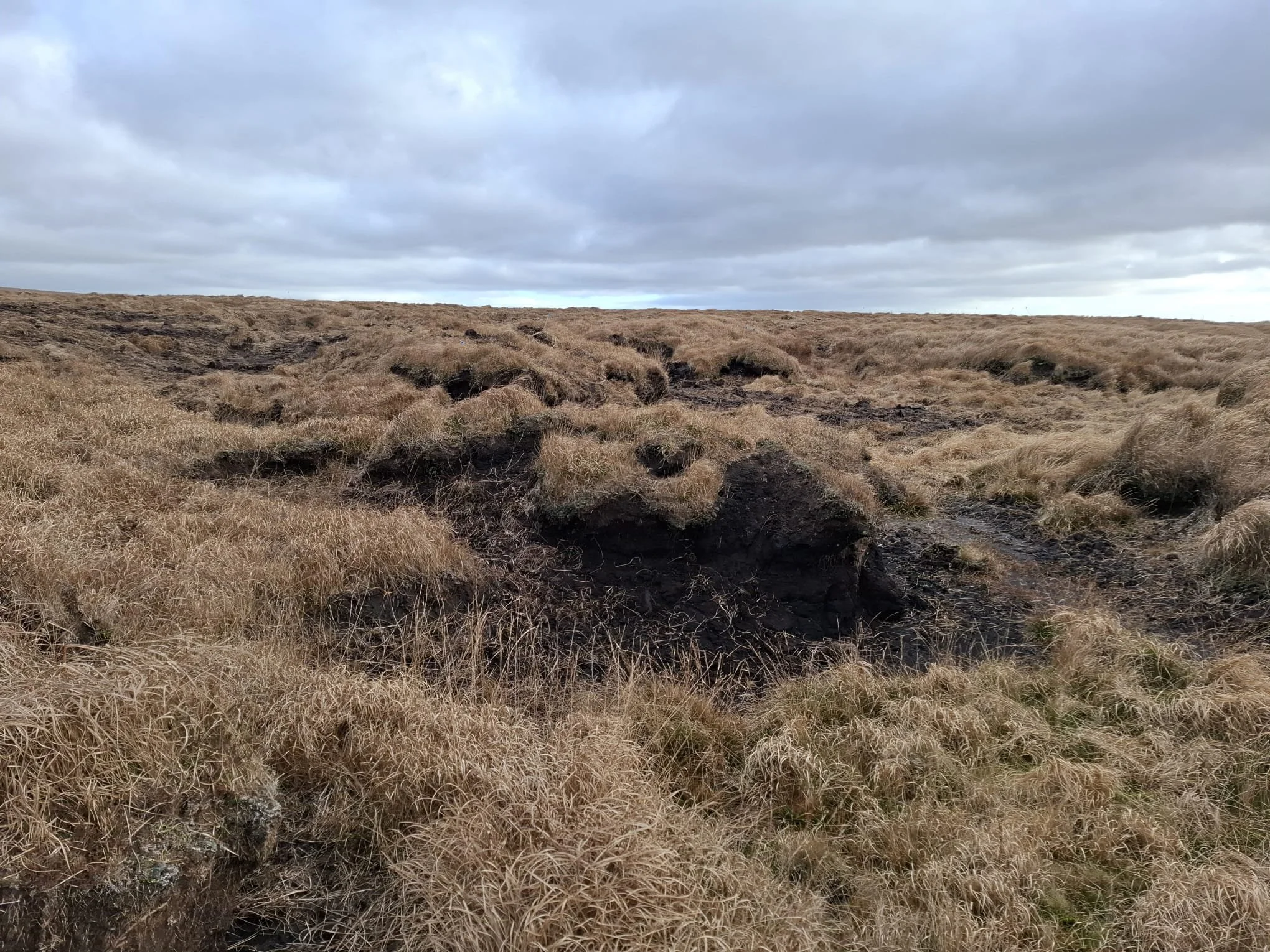
Eroding area of peatland at Tavy Head, before restoration works took place to reprofile bare peat edges, block channels and raise the local water table
Why did SWPP audit the carbon output of restoration works?
It is well understood that there are significant benefits to restoring degrading peatlands in terms of reducing greenhouse gas emissions. However, it is important to understand how these reductions balance against the emissions associated with the restoration activities themselves such as the use of excavators, materials, staff travel etc.
In order to improve this understanding for our work here in the UK’s South West, SWPP carried out a carbon audit for a typical year of activities from April 2023 until April 2024. This would identify the true net benefit, in terms of greenhouse gas emissions, of carrying out this important work for people and nature.
What were the practicalities, and challenges, of carrying out the audit?
A large amount of data was required in order to carry out this audit. This involved SWPP staff looking through invoices for material orders like timber and stone to find out how much material had been used at a given site, liaising with our many contractors to collect information on how much fuel was burnt during the restoration season per site, or collating trips and journeys made by staff, volunteers and contractors to identify the carbon footprint of everyone travelling. This, and many more pieces of data, came together, and with the help of the Net Zero team at South West Water we were able to calculate SWPP estimated emissions over the course of a year.
For the other side of the carbon story, and understand the carbon volume out there in the peatlands we work on, contractors and staff headed out onto Dartmoor and collected peat depth and condition data for our study site. They then checked, cleaned and converted this data into a useable format to identify the potential carbon savings from work carried out.
Why is carbon dioxide important to reduce?
Carbon dioxide (CO2) is a greenhouse gas that plays a key role in warming the Earth’s atmosphere by trapping heat from the sun. This is an essential process that helps to maintain a habitable temperature on Earth. However, in recent history, humans have dramatically increased emissions of greenhouse gases, causing the climate to warm at a much faster rate.
In order to help combat the effects of global warming, the UK government has committed to achieving Net Zero GHG emissions by 2050.
Why are peatlands important for carbon storage, and how is that threatened?
Emissions of CO2 derive from a variety of sources, including both natural and human activities. Peatlands are of international significance due to the vast amount of carbon that is stored in the partially preserved plant material that lies within the waterlogged peat. There is estimated to be more than 600 billion tonnes of carbon stored in peat soils across the globe, which represents as much as 44% of all soil carbon. This figure also exceeds the carbon stored in all other vegetation types, including the world’s forests. In the UK, peatlands account for 12% of land cover and store just over 3 billion tonnes of carbon.
However, our peatlands have been cut for fuel, mined and burned, leaving them in a degrading and declining condition. When peatlands erode, this carbon can be released as CO2. It is estimated UK peatlands release around 23 million tCO2e yr-1. This accounts for 5.97% of the UK’s emissions, based on end user greenhouse gas emissions in 2023. Therefore, peatland restoration has the potential to provide a major contribution to the UK’s NetZero by 2050 target.
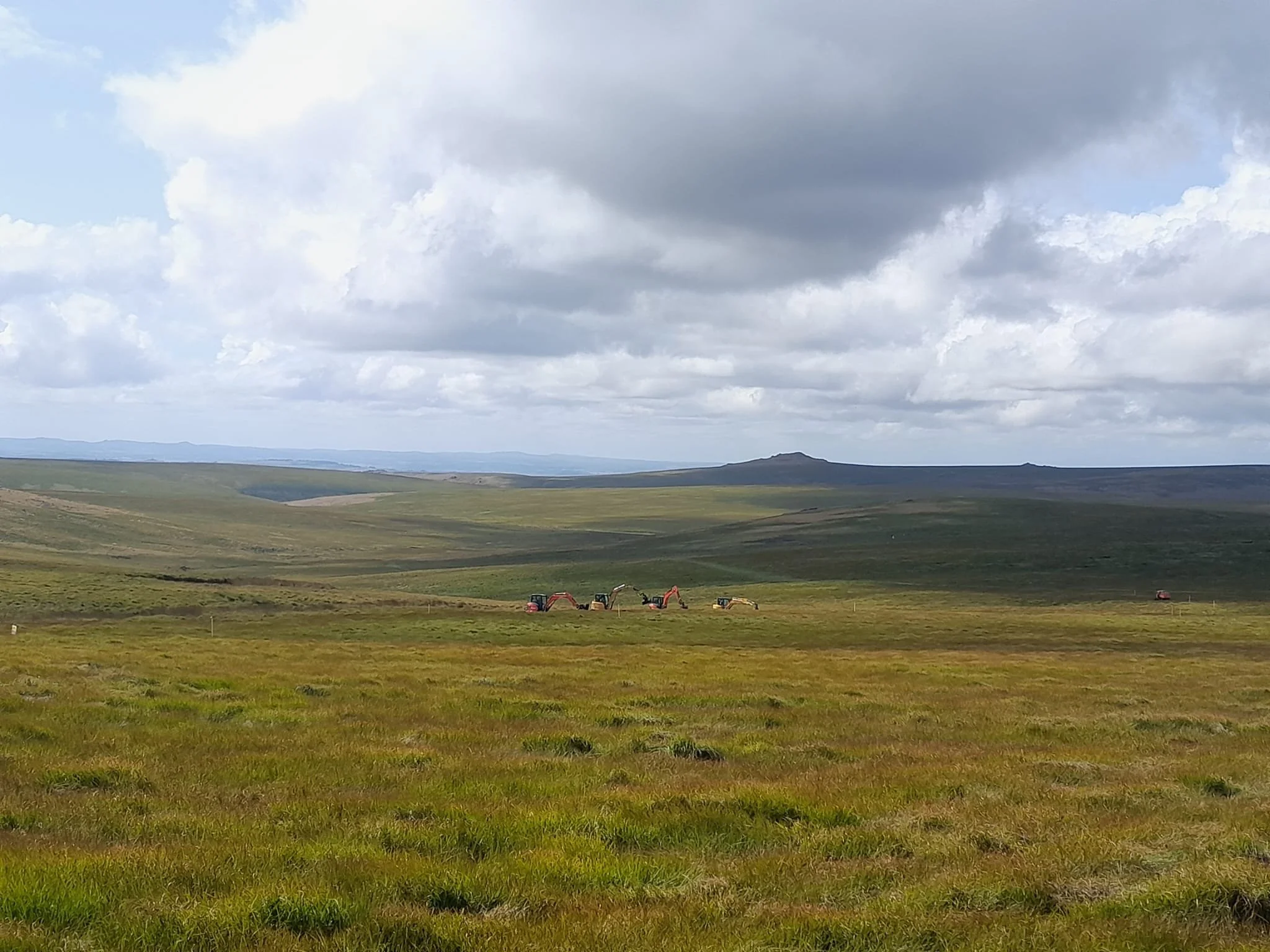
Low-ground pressure machinery out on North Dartmoor carrying out peatland restoration interventions, August 2026
If we don’t restore this vast peat and carbon store below our feet on the blanket bog of Dartmoor, or valleys of Cornwall, it will continue to erode and wash away into local waterways.
Peatland restoration isn’t just about carbon. It’s also invaluable in increasing the diversity of insects, birds and plant species living on our moorland and valley areas. Our work also helps to slow the flow of water that can rush off uplands in heavy rainfall and hold water back in the landscape during times of drought and dry weather. With the changing climate, it’s vital to do this work now to make our peatlands more resilient to the extremes of weather we will, and already, see.
Further reading
Moors for the future carbon audit 2021, conducting a review of activities, carbon associated with lifting materials to site, and making recommendations for their reduction for this partnership’s work in the Peak District.
BBC News Article. This news report we took part in illustrates the findings of a study published in 2025, that current climate models project it to be challenging for blanket bog to form on areas of the South West and the rest of the UK past 2060. But its not a done deal, and the researchers highlight the importance of restoration work to get these areas as wet, hydrologically functioning, resilient and thriving as possible now.